
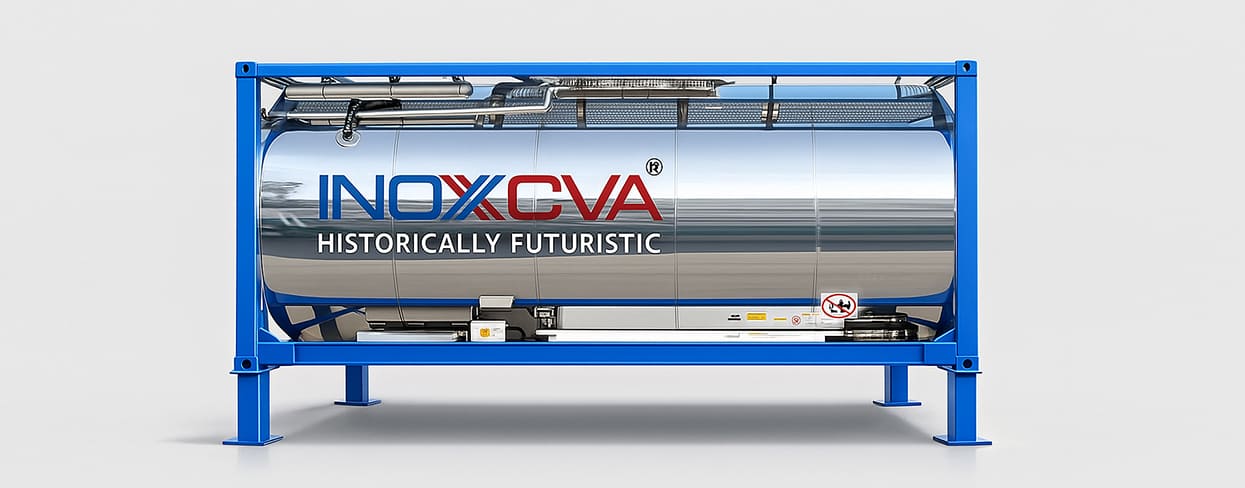
Safety is very critical when it comes to ammonia transportation, which can be achieved only through modern material science, high-precision engineering, and superior manufacturing. While applications for ammonia are very wide, ranging from refrigeration to fertilizers to chemicals, the hazardous nature of this chemical demands the best practices in safety during transportation.
At INOXCVA, safety is fundamental to our design philosophy. Every ammonia storage tank we construct is designed to ensure safe transportation without affecting the environment while delivering superior performance. We acknowledge that ammonia’s application across different industries demands safe transportation in day-to-day operations.
Understanding the chemical nature of ammonia
Before proceeding with the design considerations for the ammonia storage tanks, some preliminary understanding of this chemical is required. Ammonia is composed of one atom of nitrogen joined with three atoms of hydrogen. Because of its unique properties and chemical makeup, ammonia is adaptable for use in many industrial applications. It is this chemical structure that gives ammonia its characteristic properties, making it a weak base with the capability of forming stable compounds with a variety of other substances. These properties have to be taken into consideration when designing tanks for their transportation in a safe manner.
The gas easily forms a white cloud upon exposure to air, especially in moist conditions, due to its reaction with water vapour. Such a reaction with water vapour should be noted while handling and storing ammonia to avoid any hazard and environmental effects.
Physical properties of ammonia
Ammonia is lighter, as a vapour, compared with air; therefore, it rises. It is flammable within a narrow range of concentrations and easily ignites in the presence of an ignition source. In addition, ammonia produces serious burns, particularly if it contacts skin or eyes. These physical properties demand careful design for ammonia storage tanks for safe transportation.
Protective installations that make INOXCVA ammonia storage tanks safe for transport:
- Safety relief valves for releasing undue pressure
- Emergency shut-off systems
- High-quality insulation to maintain temperature during transit
- Outer jackets for protection against physical impact damage
These features ensure the tank is stable and secure even under unexpected conditions.
Importance of safe ammonia transport
The safe transport of ammonia is critical; it protects human health, safeguards the environment and ensures the safety of infrastructure. Given these high stakes, let’s examine the key risks involved and the regulatory standards that govern secure ammonia transportation.
There are several dangers in transporting ammonia, mostly due to its toxicity and flammability. In the case of leakage or accidental spill, ammonia can immediately disperse and form a toxic gas cloud that can be dangerous for both the personnel in transportation and the people in proximity. Ammonia vapours can further come into contact with other substances and ignite, causing fire or even explosions.
Given these significant risks, safety in ammonia transport must be uncompromising. At INOXCVA, this principle is embedded in our engineering. Our ammonia transport solutions are designed with integrated safety protocols, including robust construction for integrity, advanced monitoring systems for real-time tracking, and designs that facilitate rigorous maintenance and inspection. We build not just for efficiency, but to ensure the absolute safety of personnel, the public, and the environment.
How are the INOXCVA tanks designed?
These tanks are constructed of high-strength, corrosion-resistant materials. Ammonia is a corrosive chemical, especially under conditions of high moisture. To resist corrosion for long periods, INOXCVA tanks are fabricated from:
- High-grade carbon steel or stainless steel
- Special corrosion-resistant alloys
- Low-temperature–compatible materials for enhanced durability
Every sheet, weld, and component is selected to ensure the tank cannot be degraded by the chemical nature of ammonia.
Robust Design of Pressure Vessels under Extreme Conditions
Ammonia is transported as a liquid under pressure, and therefore, the pressure vessel integrity is a critical factor. INOXCVA uses:
- Finite Element Analysis (FEA) for structural verification
- Optimized wall thickness for safe stress distribution
- Leak-proof operation thanks to reinforced nozzles and fittings.
- Design codes, such as the ASME Section VIII for design, to maintain the global safety standards.
These parameters ensure that the tank can support pressure fluctuations in case of filling, unloading, or transport.
Advanced welding technology for zero leaks
Leak prevention is the most important factor in transporting ammonia. INOXCVA achieves this by:
- Automatic and semi-automatic welding processes
- Non-destructive testing includes radiography, ultrasonic testing, and dye penetrant inspection.
- 100% weld quality verification
Every weld undergoes stringent testing to eliminate even microscopic imperfections.
The most sensitive parts of an ammonia storage tank are the valves and pipelines. INOXCVA designs them to be compatible with ammonia, resistant to corrosion, easy to operate even in emergencies, fitted with advanced mechanisms of isolation and pressure, leakage, and endurance tested. This ensures smooth loading and unloading with minimum operator intervention and maximum safety.
Conclusion
Safe transport of ammonia is all about meeting standards. INOXCVA is at the forefront of these innovations in the design and fabrication of state-of-the-art cryogenic storage tanks for LNG, liquid hydrogen, and even fusion energy applications. Their expertise is helping mainstream clean energy technologies by ensuring that these cryogens can be stored and transported safely.