
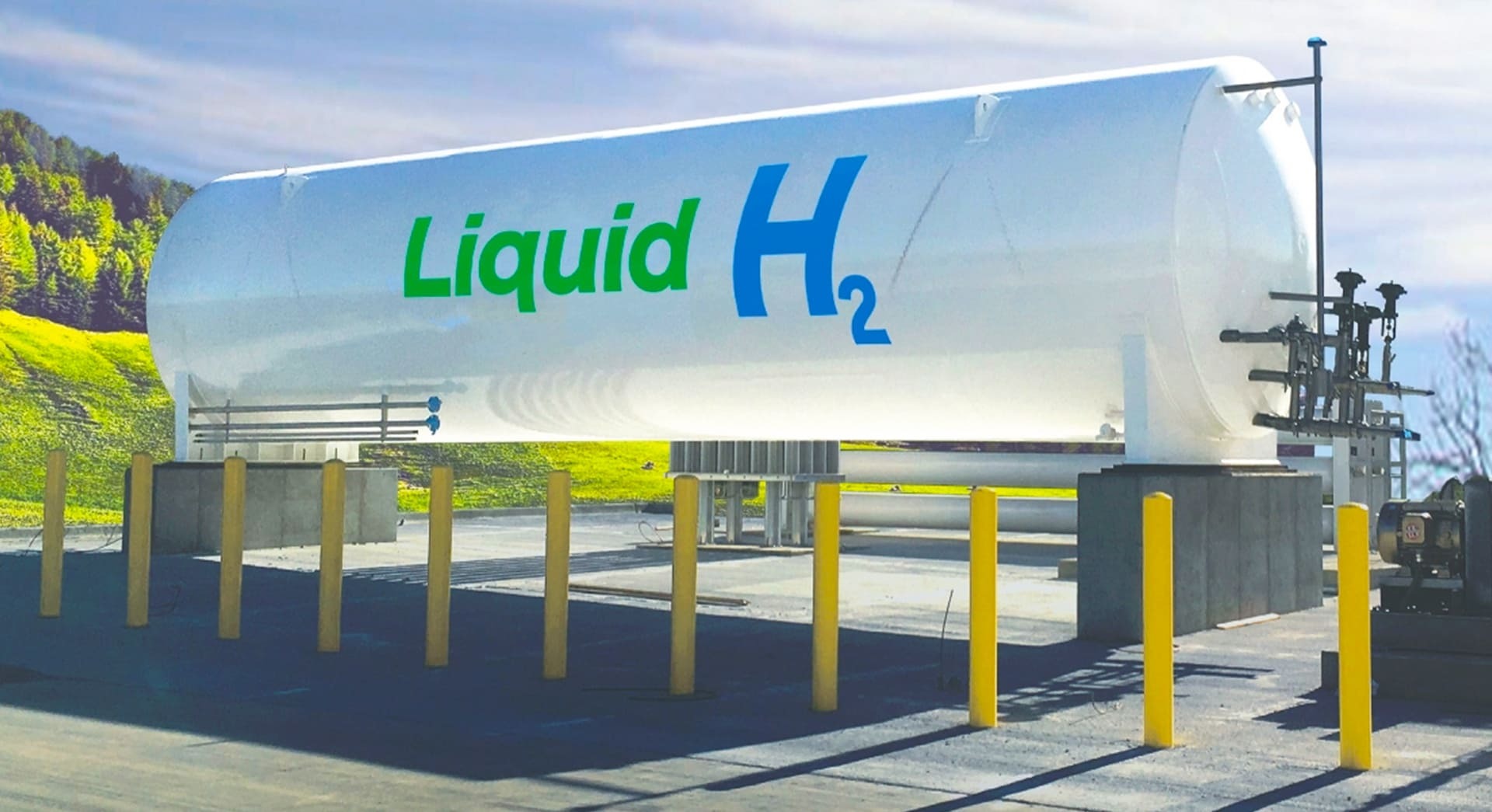
Hydrogen, the universe’s most abundant element, holds the key to a truly zero-emission energy future. While often discussed in its gaseous form, its most powerful and practical state for transportation and storage is its liquid form: Liquid Hydrogen (LH₂).
Converting Hydrogen gas into a liquid is a monumental task of cryogenics, but the resulting fuel is a marvel of physics and engineering. From powering humanity’s leap to the moon to potentially revolutionizing terrestrial transport, LH₂ is a core component of the clean energy transition.
Here are some fascinating facts about this cold, powerful fuel:
The Extreme Temperature Barrier
The most striking fact about Liquid Hydrogen is the extreme temperature required to maintain its state. To liquefy Hydrogen gas, its temperature must be dropped to below its boiling point of approximately −253°C (-423°F), which is just 20 degrees above absolute zero (0 Kelvin).
According to the U.S. Energy Information Administration (EIA), Hydrogen must be liquefied by cooling it to below −253°C (-423°F). This level of cold makes LH₂ one of the coldest liquids known to science and is why we categories it as a cryogenic fluid. Dealing with temperatures this low requires highly specialized, vacuum-insulated containers and pipes (cryolines) to prevent heat from the environment from causing the liquid to boil and revert to gas. This technological necessity has driven massive advancements in the field of cryogenics.
Density: Small Volume, Massive Energy
Hydrogen is famous for its high energy content by weight, but Hydrogen gas takes up enormous volumes. Liquefaction is the engineering solution to this storage challenge.
When Hydrogen is liquefied, its density dramatically increases. As noted by Stargate Hydrogen, liquefying Hydrogen reduces its volume by a factor of over 800, allowing it to be stored compactly in tanks. This compact storage capacity is fundamental to its utility in demanding applications like rocketry.
Furthermore, its energy density by mass is approximately three times greater than that of gasoline. Data from the DOE’s Hydrogen Storage program confirms that Hydrogen has nearly three times the energy content of gasoline by mass (120 MJ/kg for Hydrogen versus 44 MJ/kg for gasoline). This is the single most compelling reason why LH₂ is the ideal fuel for any application where weight is a primary constraint.
The Rocket Fuel That Sent Man to the Moon
The history of LH₂ is inextricably linked with space exploration. It is no exaggeration to say that Liquid Hydrogen was the essential ingredient in the success of the Apollo missions.
According to space.com, NASA’s history of the Apollo Program details the pioneering use of Liquid Hydrogen and Liquid Oxygen (LOX) as propellants for the powerful Saturn V rocket. Today, modern space propulsion systems, including NASA’s Space Launch System (SLS) and rockets from private ventures, continue to rely on LH₂. This preference stems from the fact that it yields the highest specific impulse (efficiency) of any non-nuclear chemical rocket propellant, allowing massive payloads to escape Earth’s gravity.
An Environmentally Impeccable Exhaust
Perhaps the most important fact about Liquid Hydrogen for the future of our planet is its environmental profile. When LH₂ is used in a fuel cell (or even combusted cleanly in an engine), the only emission is pure water vapour H₂O.
The U.S. Department of Energy emphasizes that Hydrogen is a clean fuel that, when consumed in a fuel cell, produces only water. This makes it a true zero-emission fuel, offering a perfect solution for decarbonizing heavy industries, shipping, and long-haul road transport, where batteries often fall short on range and charging time. The global shift toward LH₂ is not just about power; it’s about eliminating harmful pollutants from transportation networks entirely.
Advantages of Liquid Hydrogen as a Fuel
The Advantages of Liquid Hydrogen as a fuel are numerous, but they centre on performance and environmental sustainability, particularly when compared to other forms of hydrogen storage.
When it comes to hydrogen storage, Liquid Hydrogen (LH₂) offers significant advantages over Gaseous Hydrogen (GH₂). While gaseous hydrogen requires high-pressure cylinders (up to 700 bar) and occupies substantially more space, LH₂ is cooled to −253°C, making it far denser and more compact. This means more energy can be stored in less volume, which is ideal for large-scale applications like space missions, high-capacity hydrogen refueling stations, and clean mobility solutions that require maximum range.
In terms of operational efficiency, LH₂ enables faster refueling, longer driving ranges, and easier transportation over long distances compared to compressed gas. Its high energy-to-volume ratio and lower storage footprint make it the preferred choice for industries and countries working towards zero-emission energy systems and scalable hydrogen infrastructure. Beyond its use in rocket engines and future road transport, its flexibility allows it to be utilized in fuel cells to generate electricity directly or combusted in turbines for power generation, offering diverse utility across the energy spectrum.
The Transportation Challenge: Keeping It Cold
The major hurdle facing widespread LH₂ adoption isn’t production; it’s storage and distribution. Maintaining a temperature of −253°C across pipelines, trailers, and fueling stations requires an unbroken chain of cryogenic containment.
This presents a vast engineering challenge, requiring incredibly sophisticated vacuum technology and highly efficient materials to limit the “boil-off” rate (the natural evaporation of the liquid due to unavoidable heat transfer). The infrastructure supporting this temperature integrity is complex, demanding highly specialized cryogenic systems, from small mobile dewars to massive stationary storage tanks.
Advancing the Global Liquid Hydrogen Infrastructure
The future success of Hydrogen as a clean energy carrier depends entirely on building this robust cryogenic infrastructure. As a leader in pioneering cryogenic storage and transport solutions, INOXCVA is at the forefront of enabling the global shift toward Hydrogen. We are leveraging our deep expertise in handling extreme cold to provide the specialized storage and transport tanks necessary for large-scale LH₂ projects. By designing and manufacturing these sophisticated cryogenic systems, we are directly helping to lower distribution costs and enhance the reliability of the LH₂ supply chain, advancing Liquid Hydrogen infrastructure and making the promise of this carbon-free fuel an operational reality across industries worldwide.
Contact INOXCVA today for high-performance Liquid Hydrogen storage and transport solutions, enabling reliable, safe, and large-scale hydrogen projects.