
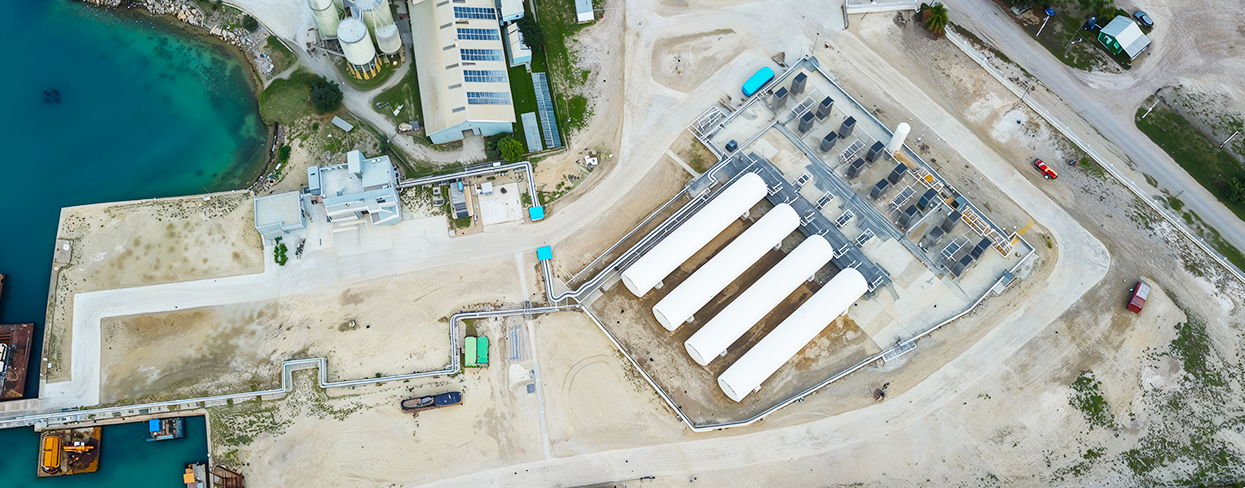
At INOXCVA, our legacy in cryogenic innovation extends far beyond industrial gases and cryogenic storage. As a trusted solutions provider in the energy ecosystem, we also support infrastructure critical to global energy distribution – including the design, engineering, and supply of equipment for Liquefied Natural Gas (LNG) terminals.
An LNG terminal is a complex facility designed to receive, store, re-gasify, and distribute liquefied natural gas. These terminals require a precise orchestration of highly engineered equipment to ensure safety, efficiency, and uninterrupted operations.
Here are the 10 essential pieces of equipment commonly found in an LNG terminal:
1. LNG Storage Tanks
Purpose: Store liquefied natural gas at cryogenic temperatures.
Description: These massive, double-walled insulated tanks are engineered to maintain LNG at approximately -162°C (-260°F), preserving it in a liquid state. They are designed to minimize boil-off gas (BOG), withstand high internal pressure, and enable efficient long-term storage.
2. LNG Pumps
Purpose: Transfer LNG between storage tanks and terminal process areas.
Description: These cryogenic pumps maintain flow while keeping LNG at extremely low temperatures. They are essential for ensuring the steady movement of LNG from tanks to vaporizers or ships.
3. Liquefaction Units
Purpose: Convert natural gas into liquid form for easier transport and storage.
Description: Liquefaction involves multiple processes, including compression, pre-cooling, and condensation. The gas is cooled to -162°C using refrigerants, transforming it into LNG. While this is more common at export terminals, modular liquefaction units are also used in micro-LNG hubs.
4. Regasification Units
Purpose: Convert LNG back into gaseous form for pipeline distribution.
Description: Regasification systems utilize vaporizers – often based on seawater or ambient air – to heat LNG. This process turns it back into its gaseous form, allowing it to be injected into the natural gas grid. Efficiency and speed are crucial at high-demand terminals.
5. Loading Arms
Purpose: Enable secure transfer of LNG between ships and onshore facilities.
Description: Marine loading arms are engineered to handle cryogenic temperatures and dynamic conditions (waves, tides, etc.). They enable the safe and controlled loading and unloading of LNG to and from LNG carriers.
6. Boil-Off Gas (BOG) Compressors
Purpose: Manage vaporized gas from LNG tanks or pipelines.
Description: Even with insulation, some LNG vaporizes (boil-off). BOG compressors capture and re-compress this gas to prevent pressure buildup and loss. Re-liquefaction systems may also be integrated downstream.
7. Vaporizers
Purpose: Heat LNG for conversion back to gas.
Description: Various vaporizer types are used depending on capacity and environment. Common types include Open Rack Vaporizers (ORVs), Submerged Combustion Vaporizers (SCVs), and Ambient Air Vaporizers (AAVs). These systems ensure continuous flow into gas pipelines.
8. LNG Heat Exchangers
Purpose: Maintain efficiency and thermal control during LNG processes.
Description: These specialized heat exchangers operate under extreme cryogenic conditions to facilitate both liquefaction and regasification. Their performance directly impacts fuel economy and process stability.
9. Flare Systems
Purpose: Handle excess gas safely during upsetting or emergencies.
Description: Flare stacks burn off gas that cannot be captured or stored, ensuring system safety. These are designed with ignition redundancy and are strategically located to minimize risk to personnel and infrastructure.
10. Safety Systems and Controls
Purpose: Monitor and mitigate operational risks.
Description: LNG terminals deploy advanced fire suppression systems, gas leak detectors, thermal cameras, and automated emergency shutdown (ESD) systems. Control rooms interface with distributed control systems (DCS) to monitor and coordinate terminal-wide operations.
INOXCVA’s Role in the LNG Ecosystem
At INOXCVA, our cryogenic solutions extend into many of these systems – from storage vessels and cryogenic piping to transfer equipment and thermal insulation. With over six decades of engineering leadership, we provide custom solutions that meet international standards for safety and performance.
The equipment in an LNG terminal is engineered for resilience. Each component – from LNG pumps to flare stacks – plays a non-negotiable role in maintaining safety, uptime, and throughput in a cryogenic environment. For terminal operators and EPC firms, understanding these components is crucial for mitigating risk and achieving operational excellence.
As an industry leader in cryogenic solutions, INOXCVA is proud to support LNG infrastructure worldwide. To learn more about our advanced cryogenic offerings, including the INOXCVA UHP Ammonia ISO Tank Container and our LNG-aligned product portfolio, connect with our team today.